In this glossary we will see the most important terms of the summary of week 4 of the matter of heat transfer
Convection heat transfer coefficient
noun
The convective heat transfer coefficient, h, can be defined as: The rate of heat transfer between a solid surface and a fluid per unit surface area per unit temperature difference.
Example: The heat transfer coefficient or film coefficient, or film effectiveness, in thermodynamics and in mechanics is the proportionality constant between the heat flux and the thermodynamic driving force for the flow of heat
es: Coeficiente de transferencia de calor por convección
critical reynolds number
noun
A Reynolds number at which the flow of a fluid changes from laminar to turbulent. noun.
Example: The critical Reynolds number is associated with the laminar-turbulent transition, in which a laminar flow becomes turbulent.
es: número de Reynolds crítico
Friction Coefficient
noun
Coefficient of friction is defined as the ratio of the force required to move tow sliding surfaces over each other, and the force holding them together
Example: frictional coefficient properties, it is worth knowing how to calculate the coefficient of friction.
es: Coeficiente de fricción
Kinematic viscosity
noun
The kinematic viscosity is an atmospheric variable defined as the ratio between the dynamic viscosity μ and the density ρ of the fluid
Example: The coefficient of kinematic viscosity (or, more commonly, the kinematic viscosity) is a convenient numerical form in which the magnitude of the viscosity of a fluid is often expressed.
es: Viscosidad cinemática
laminar flow
noun
Laminar flow or laminar current is called the movement of a fluid when it is ordered, stratified or smooth. In laminar flow, the fluid moves in parallel sheets without intermingling and each fluid particle follows a smooth path, called a streamline.
Example: Laminar flow is typical of fluids at low velocities or high viscosities, while low viscosity, high velocity, or high flow fluid flows are often turbulent.
es: flujo laminar
nusselt number
noun
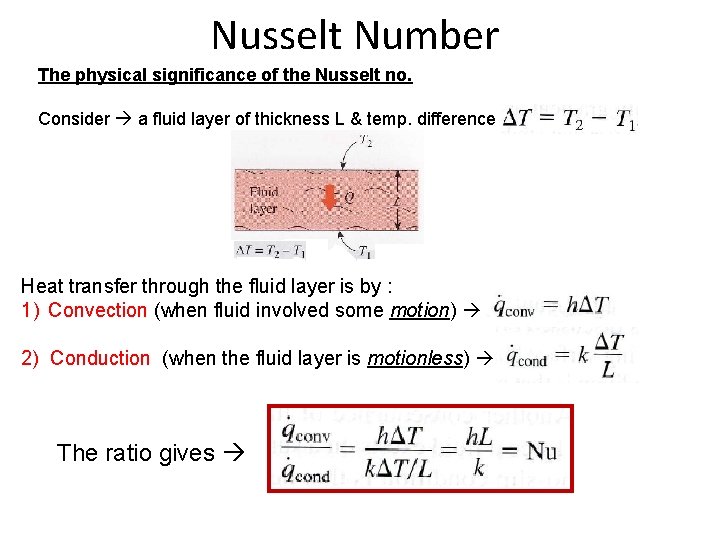
a dimensionless parameter used in calculations of heat transfer between a moving fluid and a solid body.
Example: the Nusselt number takes the value of the unit. On the other hand, for higher Rayleigh numbers, the heat transfer is a combination of conduction and convection, and the Nusselt number takes on higher values.
es: número de nusselt
prandtl number
noun
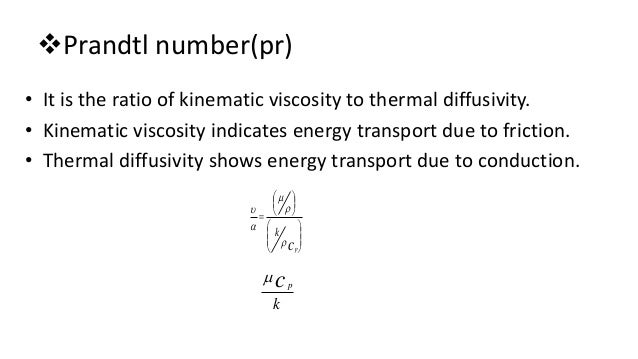
The Prandtl number (Pr) is a dimensionless number proportional to the quotient between the diffusion rate of the amount of moment (viscosity) and the thermal diffusivity.
Example: On the other hand, for motor oil, convection is very efficient transferring heat compared to conduction, therefore the Prandtl number is high.
es: número prandtl
reynold number
noun
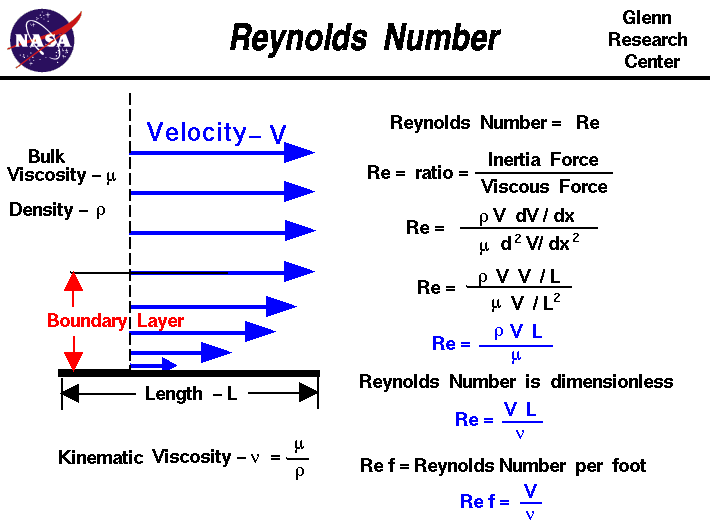
The Reynolds number (Re) is a dimensionless number used in fluid mechanics, reactor design, and transport phenomena to characterize the motion of a fluid.
Example: but the Reynolds number was named by Osborne Reynolds (1842-1912), who popularized its use in 1883.
es: número de Reynold
Shear stress
noun
Shear stress, often denoted by τ (Greek: tau), is the component of stress coplanar with a material cross section.
Example: The formula to calculate average shear stress is force per unit area.
es: Esfuerzo cortante
turbulent flow
noun
Turbulent flow, type of fluid (gas or liquid) flow in which the fluid undergoes irregular fluctuations, or mixing, in contrast to laminar flow, in which the fluid moves in smooth paths or layers.
Example: In turbulent flow the speed of the fluid at a point is continuously undergoing changes in both magnitude and direction.